

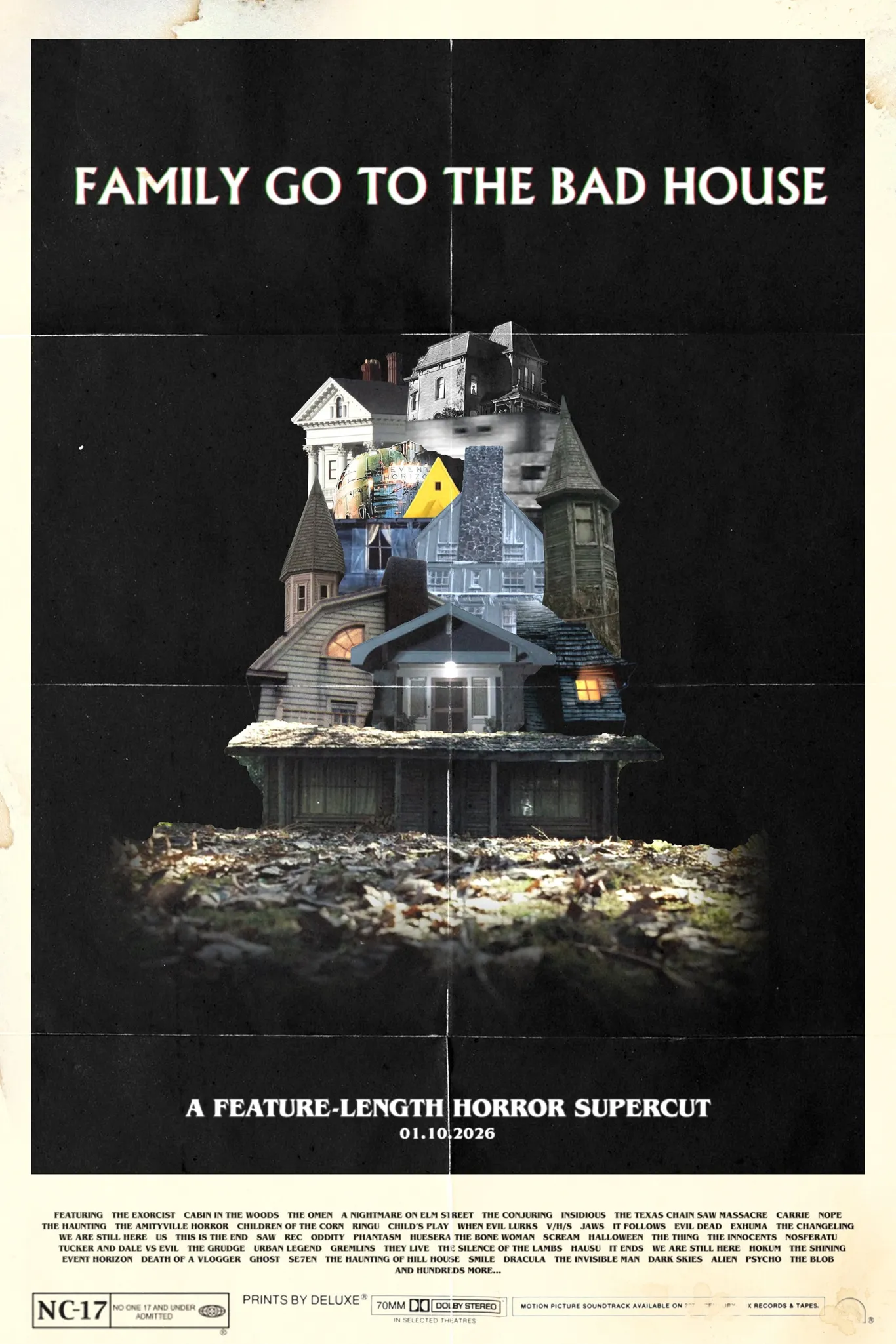
Family Go to the Bad House
The supercut has always been an effective format for laying bare clichés, ridiculing overused tropes and exposing hackneyed lines of dialogue. But Graham Hughes takes the format a step further: rather than focusing on a single convention, he tackles an entire genre. His Family Go to the Bad House is a veritable compendium of horror clichés, assembled into a narrative supercut. He combines clips from hundreds of horror movies, grouping together recurring characters, situations and scares. (Hughes took his cue from György Pálfi’s Final Cut: Ladies and Gentlemen, an influence he gracefully acknowledges in the opening titles).
His approach highlights both the familiar patterns of horror and the inventive variations on them. Take the titular house. The buildings featured in this supercut share a surprising number of architectural features (arches, towers, imposing staircases) while otherwise ranging from humble sheds and shacks to castles and full-blown Gothic mansions. What they all have in common, however, is their isolation. More often than not, these are secluded places that are cut off from the world and surrounded by woods, fields or other ominous expanses of nature. The film establishes this geography nicely with an introductory drive through the countryside, captured in wide shots that emphasize the contrast between the openness of the natural landscape and the claustrophobic confines of the house(s). Of course, nature itself is hardly a safe haven in these horror movies: a sequence made out of shots of natural mazes (of corn, trees or reeds) suggest that the outdoors can be every bit as disorienting and frightening as the interiors.
Family Go to the Bad House also brings out some of the stylistic and narrative devices typical of the haunted-house genre. The camera, for instance, is no innocent observer but an accomplice in the horror. When the family enters their new home, it is already inside, as though it has been waiting for them. Another recurring device is the use of audiovisual technology as a conduit for terror. VHS tapes, television screens, 8mm home movies, CCTV footage and old film reels are all used to relay warnings from one world to another. More importantly, they remind us that watching horror does not necessarily place us at a safe distance from it. After all, we too are watching an audiovisual product, and our own act of looking may bring danger upon us, just as it does upon the characters on screen.
Like many other (but less ambitious) supercuts, Hughes also exposes worn-out visual clichés. Think of the ominous shot of the shower head, the monster emerging in a fogged-up mirror or lurking behind a shower curtain, the threat waiting in the bathtub… These are all familiar variations on horror’s persistent invasion of one of the most intimate spaces in the home. The person taking a bath or shower is almost invariably female, adding a gendered dimension to this recurring motif, one that Jennifer Proctor also explores in her own supercut, Nothing a Little Soap and Water Can’t Fix. And in Hughes’ feature-length supercut too, the family dynamics are shockingly conventional. Mothers remain in the kitchen with the children while fathers leave the house to go to work.
Of course, this particular format (a narrative supercut that doubles as a mashup) inevitably favours the trite and the unoriginal. To construct a narratively cohesive sequence, the editor needs several examples of comparable setpieces to work with. In the process, more singular expressions of creativity risk being filtered out. An inventive scene that puts a fresh spin on a familiar horror device may simply be too difficult to fit into the larger pattern. What remains then is the familiar and the frequently recurring.
Hughes’ narrative is episodic, as haunted-house films themselves also tend to be. There is no particularly clear goal driving the story beyond surviving the next encounter or finding a way out. The usual solution is escalation: each new threat is deadlier than the last.
The closing stretch, unfortunately, takes the film too far away from the premise established by its title. What begins as a horror story built around a family and its relationship with a sinister house eventually turns into a more generic gorefest. The family dynamics are abandoned in favour of an efficiently edited succession of supernatural mayhem and monster combat (taken from horrifying fare as diverse as Se7en and They Live, and with monsters being sourced from space and the Black Lagoon).
Ultimately, Family Go to the Bad House is an epic and entertaining exercise in horror collage. It is full of recognizable architectural, visual and narrative conventions. (And there’s a takeaway for aspiring horror actors: if you’re auditioning for a film like this, go for the expert or the exorcist. Those parts are clearly the most fun.) Want to check out the complete movie for yourself? An email to familygotothebadhouse at gmail dot com is automatically answered with a link to an online screener.